Some people unwind by scrolling. I unwind by rewinding.
There’s something about the click of a cassette deck, the soft thump of a record needle finding its groove, and the quiet snap of a typewriter key that makes my brain settle. It’s not nostalgia for me. It’s fuel.
In 2026, I’m an indie author writing mysteries and romance, and I still build my stories with a lot of analog tools. Not because I’m trying to be quirky. Not because I hate technology. I use plenty of digital stuff. I just know what works for my creative brain.
And honestly? The old-school way keeps me honest. It slows me down in the best way.
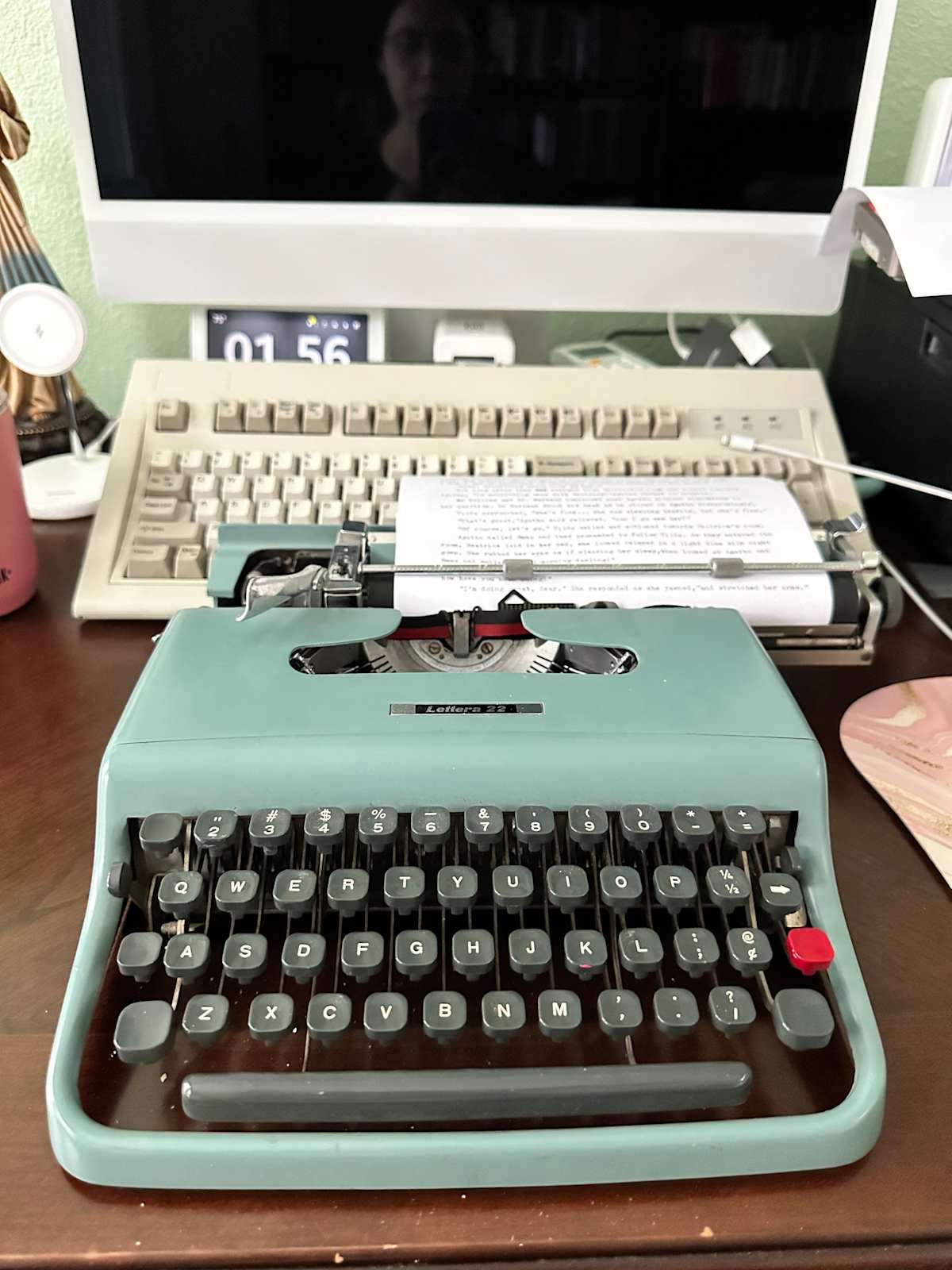
The typewriter is where my ideas behave
When I’m drafting a new story idea, I start on a typewriter.
Not the whole book. I’m not doing a full 60,000-word marathon on it. But the early stuff? The messy, exciting, “what if she did this” stage? That lives on paper first.
The typewriter helps me stop second-guessing every sentence. I can’t backspace my way into a perfect paragraph. I have to keep going. That’s exactly what a first draft needs.
When I’m stuck, I go back to it too. If a scene feels flat or I can’t hear the dialogue, I’ll set the laptop aside and sit at the typewriter like it’s a different writing room in my own house. Something changes when the words land on paper with that sharp little tack tack tack.
It feels like the story stops trying to impress me and starts telling the truth.
My soundtrack is on tape and vinyl
I love music, but I don’t love what music apps do to my focus.
With a cassette or a record, I can’t skip around forever. I can’t jump from one mood to another every ten seconds. I pick something, press play, and I commit.
That’s how I want to write, too.
When I’m plotting a mystery, I’ll put on something with steady rhythm. When I’m writing romance, I lean into softer albums that make the emotional beats feel close. Sometimes I replay the same side of a record for days until a certain scene finally clicks.
It’s like training my brain to show up when that sound starts.
Film cameras teach me how to notice things
I still shoot film. I still develop my own rolls. And yes, I also use Polaroids.
It’s not just a hobby. It’s part of how I collect details.
Film makes me look longer. It makes me wait. It makes me choose.
When I’m out with my camera, I notice little things I’d normally breeze past—how the light hits a storefront window, the way a porch swing hangs slightly crooked, the shape of fog over a lake. Those details end up in my books, especially the cozy moments between clues.
And Polaroids? They’re instant evidence.
I’ll snap photos of settings that inspire me and pin them near my desk. A coffee cup on a chipped saucer. A stretch of woods behind a cabin. A handwritten sign outside a small town shop. It’s like building my own visual clue board.
I print my books like it’s a courtroom exhibit
I write digitally, but I edit on paper. Every time.
When it’s time to revise, I print the whole book. I grab a pen, I sit down like I’m about to cross-examine my own plot, and I start marking it up.
On paper, I catch things I miss on screen:
- pacing that drags
- dialogue that sounds too “written”
- places where I skipped the fun part because I was rushing
Paper also makes it easier to see the shape of the story. I can feel where I’m cheating. I can feel where I’m hiding from the emotional beat. And I can spot where a clue needs to show up earlier.
It’s not glamorous. It’s just effective.
The one downside: my shoulder has opinions
Here’s the part where my typewriter gently informs me that I am, in fact, a human with joints.
Lately I’ve been getting shoulder pain when I type too long. That’s my sign to stop pretending posture doesn’t matter.
So I’m doing two things:
- I’m paying attention to proper technique again—chair height, wrist position, relaxed shoulders.
- I’m going back to my typewriter typing course, because it teaches the kind of positioning that keeps you from turning “creative time” into “why does my arm hate me” time.
I love the analog process, but I’m not trying to win an award for suffering. If a tool helps me write, it also needs to let me write again tomorrow.
Where my books are right now
If you’re new here, hello. I’m so glad you found me.
Right now, I’m in one of those exciting (and slightly chaotic) release seasons.
- Book 6 in the Agatha Royale series is finished and should be out next week.
- That one is done-done. The kind of done where I’ve already read it twelve times and still find one more missing comma.
- The next book in my Ashford Creek Mystery series has been completed since Thanksgiving… and I have been procrastinating the final reading pass like it’s a chore invented by villains.
The good news: I’m in the home stretch. I’m currently reading the last two chapters and the epilogue. Once that final pass is done, it’s time to release.
I’m telling you this partly because it’s true, and partly because accountability is a powerful thing when you’re staring at your own ending.
Why I keep choosing analog
Analog tools don’t make me a better writer by magic. They just make it easier for me to show up as one.
They slow me down in a world that tries to speed everything up. They pull me back into my senses—sound, texture, light, rhythm. And when you write mysteries and romance, those small sensory details matter. They’re what make a reader feel like they’re right there with you.
So yes, I write in 2026 with cassettes, records, film cameras, Polaroids, and a typewriter that keeps me humble.
And I wouldn’t have it any other way.
Now I’m curious: do you have anything “old-school” you still love using—something that makes you slow down and enjoy the process? If you do, hit reply and tell me what it is.